Services • Safety structures
Safety scaffolding in Cambridge
Crash decks, protection fans and netting - the structures that keep everything underneath the work safe while it happens.
What it is
Protecting what's underneath the work
Most scaffolding is about getting people up to the work safely. Safety scaffolding is the other half of the problem: protecting whatever is underneath while that work happens. Materials, tools and debris fall, and on a site where people are working or walking below, that has to be caught.
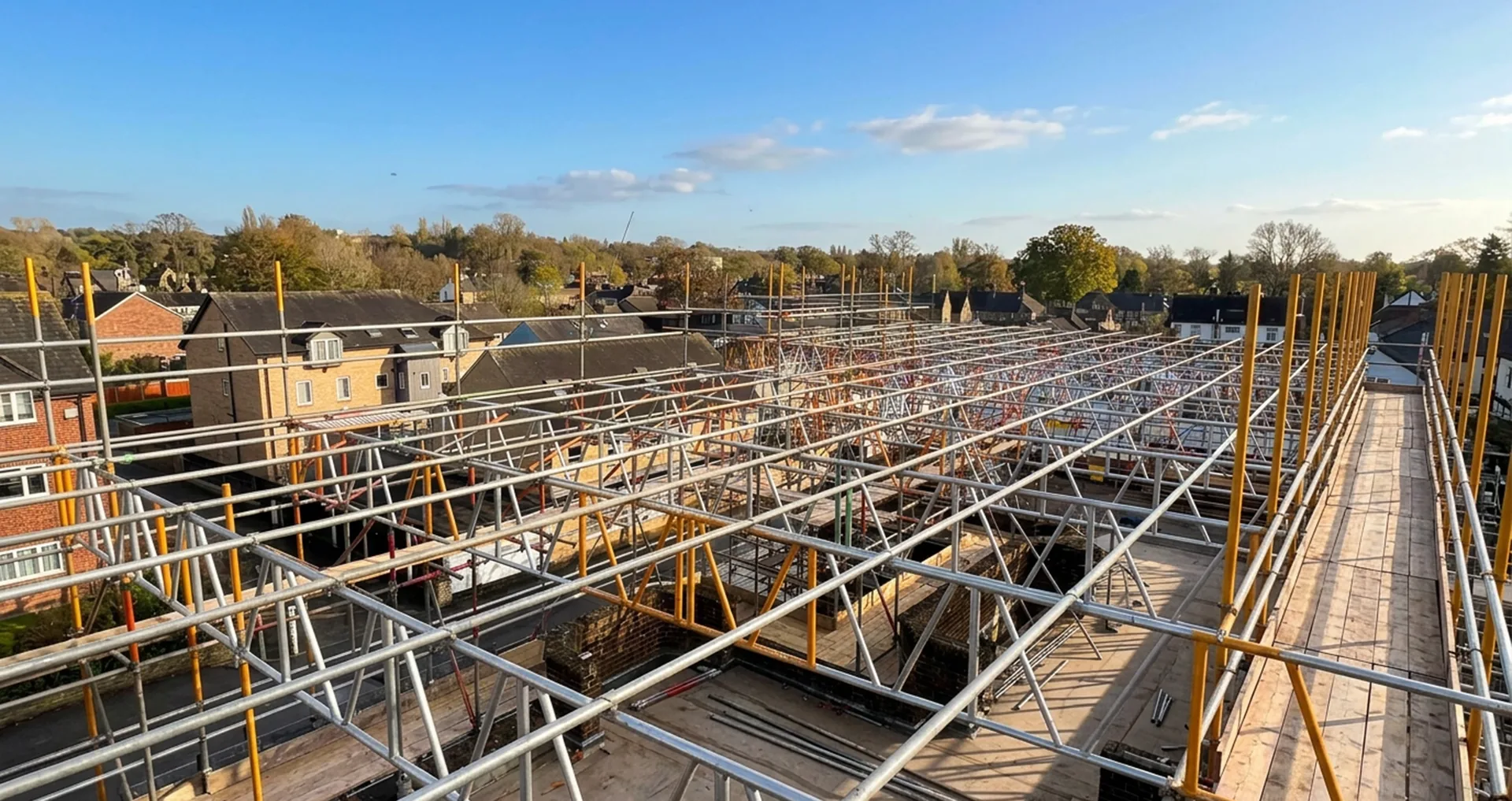
The structures do different jobs. A crash deck is a boarded platform built inside or beneath the work area to catch falling material and give a working floor. Protection fans project outward from the scaffold to deflect debris away from pavements and entrances. Debris netting and sheeting contain smaller material and dust at the face of the scaffold.
Which combination you need depends on what's below - a busy pavement, an entrance still in use, another trade working underneath, or a neighbouring property.
Why choose us
Built for what's actually below
Specified for the risk
What's underneath decides the structure. A pavement, an occupied entrance and an internal work area all need different answers.
Keeps sites open
Protection fans and decks often mean an entrance or footpath can stay in use instead of being closed for the duration.
Part of the same quote
Built into the main scaffold rather than priced as a separate job bolted on afterwards.
When you need it
When you need safety scaffolding
Work above a public pavement or a shared entrance, refurbishment where trades are working on more than one level at once, demolition and strip-out where material is coming down, work over neighbouring property or a garden that has to stay usable, and any site where the area below can't simply be closed off for the duration.
These structures are built into the main scaffold, so they're quoted alongside commercial or residential scaffolding rather than separately. Where the hazard is people falling from an edge rather than material falling onto them, edge protection and handrail is the relevant system.
We install safety scaffolding across Cambridge and the surrounding towns including Ely and Royston - see all areas we cover.
How it works
How it gets specified
What's below
A pavement, an entrance, another trade or a neighbour's garden all change what's needed.
Choosing the structure
Crash deck, protection fan, netting or a combination - matched to the actual risk rather than fitted by default.
Built with the scaffold
The protection forms part of the main structure and is checked with it before work starts.
Adapted as work moves
As the job progresses up or across the building, the protection moves with it.
Questions
Safety scaffolding, explained
Get a free quote
Tell us about the job and we'll come back with a clear price - no obligation.