Services • Edge protection
Edge protection and handrail in Cambridge
Guarding for roof edges, open floors and excavations - the practical option when the job needs fall protection rather than full access.
What it is
Fall protection without the full structure
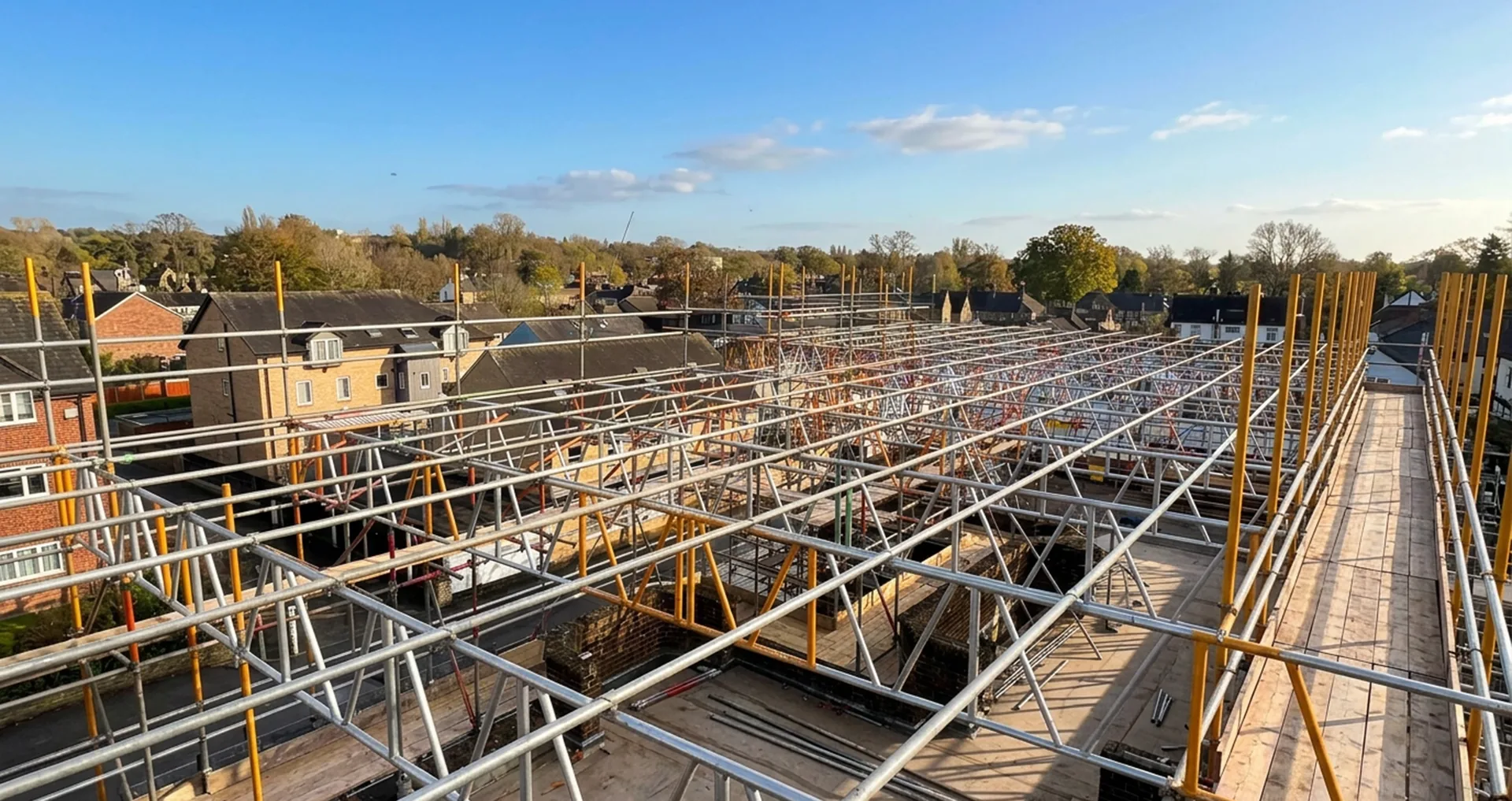
Not every job at height needs a scaffold around the whole building. Where trades are working on a flat roof, an open floor or alongside an excavation, the actual risk is falling from an edge - and the answer to that is guarding fitted along the edge itself.
Edge protection is a system of posts and rails fixed at the danger point, giving a physical barrier where someone could otherwise go over. It's quicker to install than a full scaffold, takes up far less space, and on the right job it costs a fraction of the alternative.
It's often the sensible choice for short jobs, roof-mounted plant, and anywhere a full scaffold would be disproportionate to a couple of days' work.
Why choose us
The right amount of scaffold for the job
Not over-specified
If your job doesn't need a full scaffold, we'll say so. Edge protection on its own is often cheaper, quicker and less disruptive.
Fast to install
Far less structure means far less time on site - useful when the work above is only a day or two.
Fits tight sites
Takes up almost no ground space, which matters on sites where a full scaffold has nowhere to stand.
When you need it
Where edge protection is used
Flat roof works and roof-mounted plant, solar panel installation, gutter and fascia work, open floor edges and stairwells during construction, excavation barriers, and any short job where the risk is a fall from an edge rather than a need for working access up the face of a building.
Where the job does need proper access - trades working up the elevation, materials being lifted, several days of work - residential or commercial scaffolding is the better fit, and edge protection is normally built into it. On sites where the hazard is material falling onto people below, safety scaffolding covers that instead.
We fit edge protection across Cambridge and the surrounding towns - see all areas we cover.
How it works
How it gets fitted
Tell us the hazard
What the edge is, how high it is and what work is happening near it - that decides the system.
We assess the fixing
Roof edges, parapets, steel frames and excavations all need different fixings, so we look before we quote.
Fitted and checked
The system goes in and is checked before anyone works next to it.
Removed when done
It comes off as soon as the work above is finished, same as any other structure we put up.
Questions
Edge protection, explained
Get a free quote
Tell us about the job and we'll come back with a clear price - no obligation.